In the current economic climate, digital transformation is a survival mandate. For CEOs and CFOs, the challenge isn't just going digital, but choosing a platform that scales without becoming a financial burden. Odoo has emerged as a frontrunner in this space, offering a modular approach that aligns perfectly with long-term strategic goals.
Why Odoo Fits the Modern Enterprise?
Most legacy ERP systems are rigid. They force a business to adapt its processes to the software. Odoo flips this logic. Its open-source core and modular architecture allow leaders to implement only what they need today — be it CRM, Accounting, or Inventory — and add complexity as the business grows.
For a CFO, the value lies in the Total Cost of Ownership (TCO). By consolidating fragmented apps (like using Slack for communication, Shopify for sales, and QuickBooks for accounting) into one ecosystem, companies eliminate "data silos" and reduce integration costs.
Find out more about Your Odoo Upgrade Strategy for Success
The Next 5 Years: The Evolution of ERP
The ERP landscape is shifting from "systems of record" to "systems of intelligence."
According to Gartner, by 2027, 60% of organizations replacing ERP systems will prioritize platforms with orchestration and composable capabilities, not just transactional functionality.
Key trends include:
- AI-Driven Automation. ERPs will move from manual data entry to predictive analysis. IDC predicts that AI-powered features will improve operational efficiency by 30% across mid-market enterprises by 2027.
- Hyper-Localization. As global supply chains remain volatile, ERPs will need to handle complex, local tax and compliance regulations automatically.
- User-Centric Design. The "consumerization" of enterprise software means tools must be as intuitive as a smartphone app to ensure employee adoption.
Strategic Benefits for the C-Suite
Role | Core Benefit | Strategic Impact |
CEO | Business Agility | Pivot strategies faster with live data visibility. |
CFO | Cost Consolidation | Reduced licensing fees and streamlined audit trails. |
COO | Operational Clarity | Unified workflows across manufacturing, logistics, and sales. |
Data-Backed Insights
The shift toward integrated platforms is accelerating. Reports indicate that:
- 95% of businesses report process improvement after a successful ERP implementation (Panorama Consulting ERP Report)
- At the same time, cloud-based ERP deployments now account for more than 60% of new implementations globally, reflecting the growing need for remote accessibility, scalability and stronger security (Global Growth Insights)
- Looking ahead, the global ERP market is projected to reach approximately $123 billion by 2030, driven by demand for flexible mid-market solutions and digital transformation initiatives (Grand View Research).
Moving Forward
Digital transformation is a journey, not a destination. For American business leaders, the goal is to build a "composable" business — one where the software supports innovation rather than hindering it. Odoo provides the framework to start small, scale fast, and maintain a clear view of the bottom line.
We recommend to read Sustainable ERP: How Businesses Reduce Costs, Emissions, and Risk
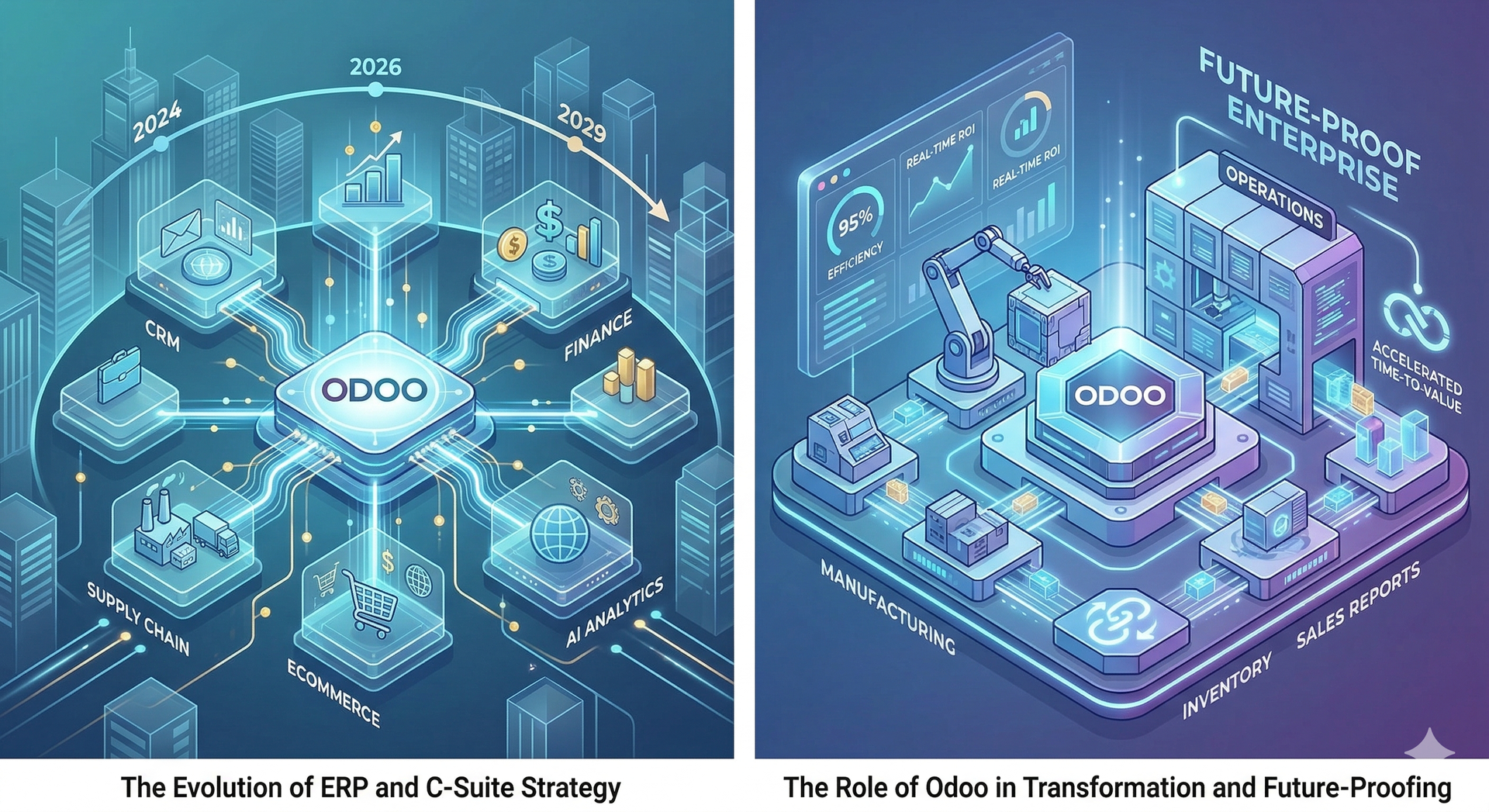
The Role of Odoo in Orchestrating Transformation
In a digital transformation strategy, the ERP serves as the "digital backbone." Odoo’s primary advantage is its ability to act as a single source of truth. For a COO or CFO, this eliminates the risk of making decisions based on outdated or conflicting data from different departments.
Key Strategic Advantages:
- Accelerated Time-to-Value. Traditional ERP implementations can take years. Odoo’s modular nature allows companies to deploy essential functions in weeks, showing stakeholders immediate ROI.
- Seamless Data Flow. By integrating front-end (E-commerce, POS) with back-end (Inventory, Accounting), Odoo ensures that a sale in New York instantly updates inventory levels in a Texas warehouse and reflects in the financial reports in real-time.
- Scalability without Complexity. As businesses expand into new markets or product lines, Odoo’s architecture allows for the addition of new apps without disrupting existing workflows. This prevents the "technological debt" that often occurs when businesses outgrow simpler software like QuickBooks.
- Customization via Odoo Studio. For unique business models, the ability to build custom apps or modify fields without deep coding knowledge empowers teams to innovate faster than competitors stuck with "off-the-shelf" limitations.
By reducing the friction between different business functions, Odoo transforms IT from a cost center into a strategic asset that drives growth.
Explore the full story How Odoo ERP optimize processes, automate sales, and increase management transparency in IT? NuxGame case study
Future-Proofing Your Enterprise
The decision to adopt Odoo is a strategic investment in long-term resilience. As we look toward 2030, the competitive advantage will belong to organizations that can turn data into action instantly. Legacy systems often act as an anchor, slowing down decision-making with outdated interfaces and disconnected information. In contrast, a modular ERP ensures that your technology stack evolves alongside your business strategy, not against it.
For the modern C-suite, the path forward involves three clear priorities: minimizing software fragmentation, maximizing data accuracy, and empowering teams with intuitive tools. By moving away from rigid, expensive platforms and embracing a flexible ecosystem, leaders can focus their energy on growth and innovation rather than troubleshooting infrastructure. Digital transformation is effectively managed when the tools simplify the work, providing a clear window into the financial and operational health of the company.
Frequently asked questions
Here are some common questions about our company.
Odoo acts as a "digital backbone," offering a modular architecture. This allows businesses to implement only essential functions (CRM, Inventory, Accounting) and scale without replacing the entire system, ensuring agility and a faster return on investment (ROI).
The primary advantage lies in the Total Cost of Ownership (TCO). Odoo consolidates fragmented apps (like Slack, Shopify, and QuickBooks) into one ecosystem, eliminating the high costs of complex integrations and multiple third-party licensing fees.
Yes. According to Gartner, by 2027, 60% of organizations will prioritize "composable" platforms. Odoo fits this trend perfectly by offering AI-driven automation and the flexibility to handle complex, local tax and compliance regulations automatically.
By providing a "single source of truth," Odoo eliminates data silos. For example, an e-commerce sale instantly updates inventory levels and reflects in financial reports in real-time, which typically improves operational efficiency by up to 30%.
No. Unlike traditional ERPs that can take years, Odoo’s modular nature allows for deployment in weeks. Tools like Odoo Studio empower teams to customize the system without deep coding knowledge, significantly speeding up employee adoption.
