Sustainability is rapidly becoming a defining factor for business competitiveness in the United States. Yet for many organizations, the biggest challenge is visibility. Without integrated data, companies struggle to measure emissions, optimize resources, or meet growing regulatory requirements.
This is where Sustainable ERP systems come in – transforming fragmented operational data into real-time sustainability intelligence that helps businesses reduce costs, improve transparency, and turn ESG goals into measurable performance.
Why Sustainability Is the New Bottom Line for U.S. Businesses?
For decades, Corporate Social Responsibility (CSR) was often treated by American executives as a “nice-to-have” – a section in the annual report primarily designed for public relations. But by 2026, the landscape has fundamentally changed and for many U.S. companies, it has become a financial, operational, and regulatory requirement.
This shift is driven by three powerful forces: regulators, investors, and consumers.
- The Regulatory Shift. While federal climate disclosure rules continue to evolve, regulatory momentum is increasingly coming from the state level. California’s Climate Corporate Data Accountability Act (SB 253) now requires large companies to disclose their full carbon footprint, including the challenging Scope 3 emissions generated across their supply chains.
- The Investor Mandate. According to the BNP Paribas ESG Survey 2025, 87% of institutional investors have maintained or increased their commitment to ESG objectives, increasingly viewing sustainability performance as a key indicator of long-term corporate resilience.
- The Consumer Demand. Sustainability is also influencing purchasing decisions. Recent data from Capital One Shopping (2026) shows that 80% of global consumers are willing to pay a premium for eco-friendly products, with the U.S. eco-friendly retail market growing 173% faster than conventional retail.
Find out more about Data-Driven Onboarding and Employee Lifecycle Management in Odoo
The ERP Connection: From Intent to Action
The challenge for many U.S. enterprises is not the intention to operate sustainably, but the ability to measure and manage their environmental impact. Without integrated data, sustainability initiatives often remain fragmented across departments. You cannot manage what you do not measure.
This is where Sustainable ERP (Enterprise Resource Planning) systems evolve from traditional back-office platforms into ESG intelligence hubs.
According to Gartner (2025), 68% of global organizations have already integrated sustainability KPIs directly into their ERP dashboards. Companies that connected emissions data with procurement and logistics systems reported an average 14% reduction in carbon intensity.
In this new reality, a Sustainable ERP becomes a single source of truth, enabling CFOs and COOs to see the environmental impact of a product as clearly as its financial margin.
Breaking the Barriers to a Greener Supply Chain
The biggest obstacle to sustainability is still fragmented data. Traditionally, environmental data such as energy consumption, waste records, or carbon offsets has been managed separately from financial and operational data like invoices, procurement, logistics, and inventory. These disconnected systems create data silos that make it difficult to understand the true environmental impact of business operations.
When sustainability data exists outside core business systems, companies risk making decisions based on incomplete information. In some cases, organizations unintentionally fall into “accidental greenwashing” – setting sustainability targets they cannot fully verify or overlooking major emissions sources within their supply chains.
You may interested in ERP for manufacturing scalability: how to choose a system that supports growth?
The Power of a Unified Data Core
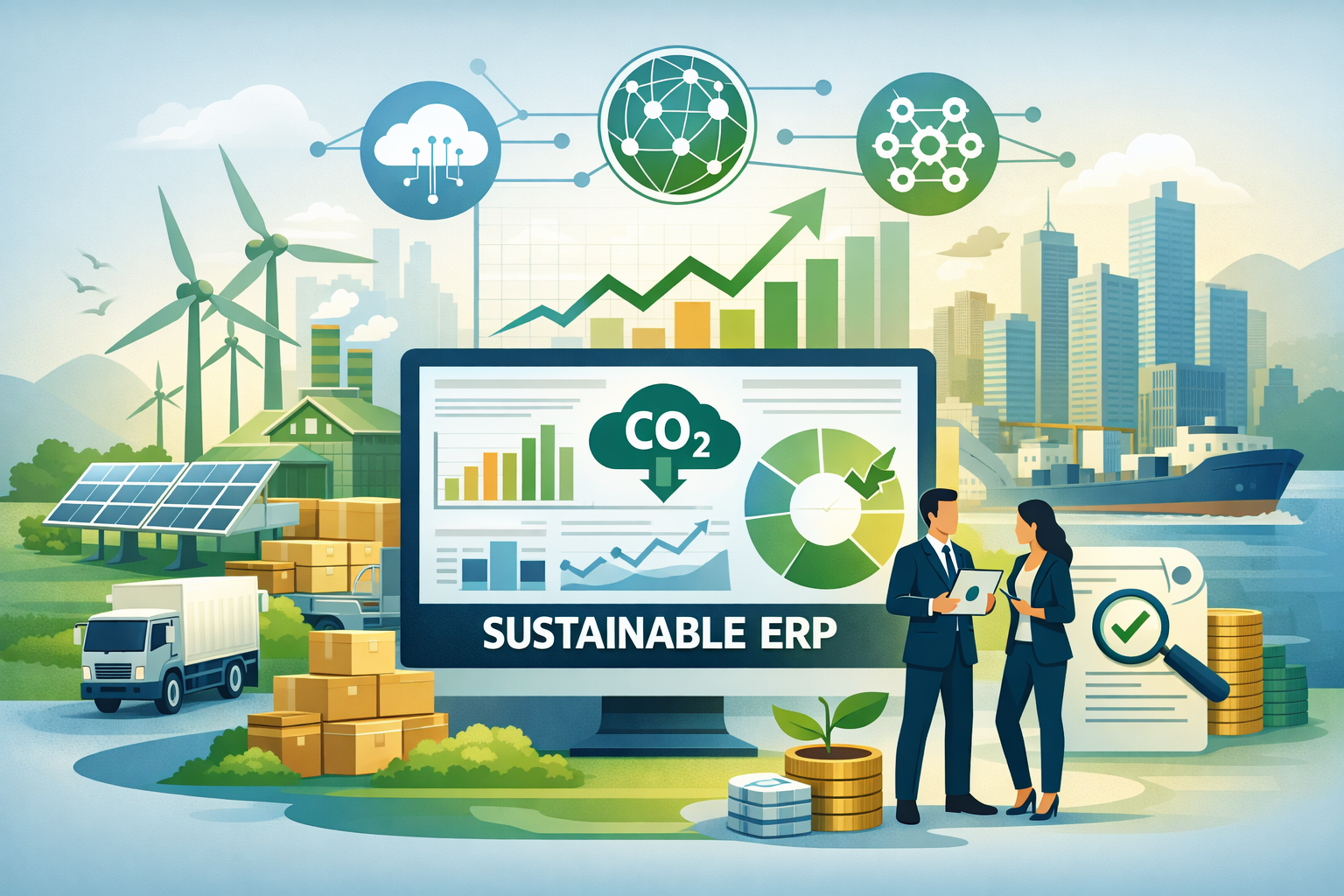
A Sustainable ERP acts as the connective layer across the enterprise. By integrating ESG metrics directly into operational workflows, companies move from static sustainability reporting to real-time environmental intelligence. Why should enterprises implement it?
- Eliminating operational blind spots. In a traditional system, a logistics manager may see only the cost per mile of transportation. In a Sustainable ERP environment, the same dashboard can show cost per mile alongside carbon emissions per mile, enabling teams to optimize both financial performance and environmental impact.
- Greater visibility into Scope 3 emissions. For many U.S. manufacturers, as much as 80–90% of their environmental impact occurs outside their own facilities – across their supply chains. Modern ERP platforms integrate supplier data, logistics information, and procurement records to provide greater transparency into these Scope 3 emissions.
- Audit-ready ESG data. As regulatory scrutiny increases – particularly with requirements such as California’s SB 253 – sustainability reporting must be backed by verifiable data. ERP systems create traceable audit trails, replacing fragmented spreadsheets with structured, reliable ESG reporting.
- Reality check. A 2025 study by SAP and Oxford Economics found that companies with highly integrated data systems are 4.5 times more likely to achieve their carbon-reduction targets than organizations relying on manual data collection.
In this way, sustainability moves from a reporting exercise to a data-driven operational strategy.
We recommend to read Drone Industry Outlook U.S. & Europe Market Trends, Forecasts, and Key Players
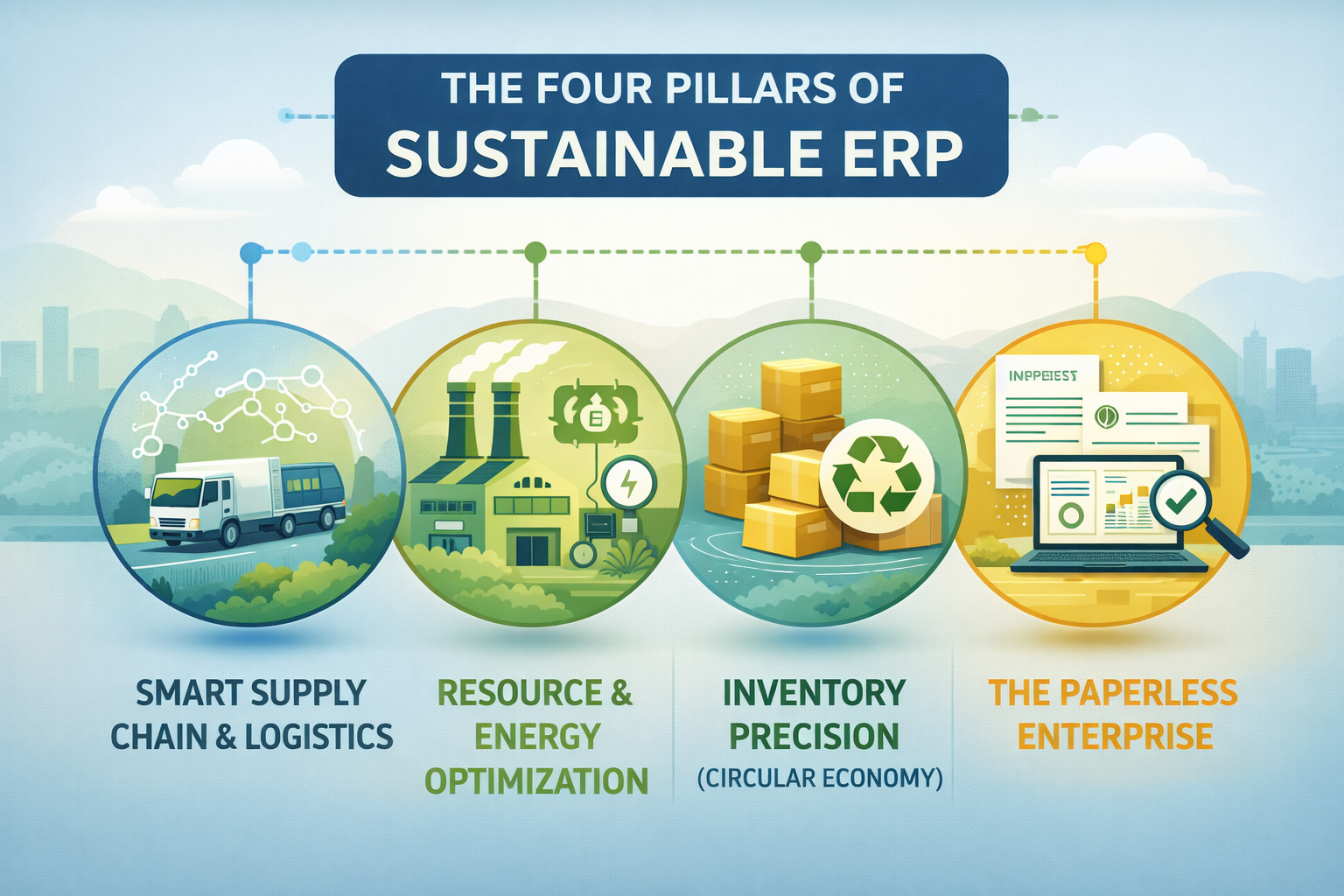
The Four Pillars of Sustainable ERP
To understand how ERP systems support sustainability, it is important to look at the operational areas where they create the most measurable impact. For U.S. enterprises, sustainability is increasingly linked to efficiency, waste reduction, and smarter resource management.
Below are four key areas where Sustainable ERP delivers both environmental and financial value.
Smart Supply Chain and Logistics
For most companies, the majority of environmental impact occurs across the supply chain rather than within their own facilities. Research shows that supply chain emissions can be more than 11 times higher than direct operational emissions.
A Sustainable ERP helps organizations gain better control over these external impacts through data-driven supply chain management. Advanced ERP systems use AI-driven logistics planning to calculate the most efficient delivery routes, helping companies reduce fuel consumption, transportation costs, and carbon emissions.
Modern ERP platforms can evaluate suppliers based on ESG-related criteria such as carbon footprint, environmental certifications, and compliance history. This allows procurement teams to align purchasing decisions with sustainability objectives.
Resource and Energy Optimization
Energy is often one of the largest operational costs in manufacturing and industrial sectors in the United States. ERP systems increasingly play a role in monitoring and optimizing how these resources are used.
Many ERP platforms integrate with IoT sensors on the factory floor to track electricity, water, and raw material usage per production unit. This provides real-time visibility into resource efficiency.
By analyzing equipment data, ERP systems can predict when machinery is likely to fail. Preventing unexpected breakdowns reduces energy spikes, production interruptions, and material waste.
Inventory Precision and Circular Economy Support
Overproduction and excess inventory contribute significantly to environmental waste across global supply chains. Modern ERP systems use machine learning models to forecast demand more accurately, helping companies produce closer to actual market needs and reduce unsold inventory.
ERP systems can also streamline product returns, refurbishment, and recycling processes. This capability is increasingly important as circular economy initiatives gain momentum in markets such as California and New York.
The Paperless Enterprise
While often overlooked, the digitalization of administrative processes can also contribute to sustainability goals.
ERP platforms automate workflows across procurement, finance, and HR, replacing paper-based processes with digital transactions. For large enterprises, moving to fully digital accounts payable and procurement systems can significantly reduce paper consumption while improving operational efficiency.
Sustainable ERP systems enable this shift by integrating environmental metrics into the same platforms companies already use to manage costs, production, and supply chains.
Learn more 10 Simple Steps to Make Odoo Work for Your Business
How much will it cost: the ROI of Sustainability
In the U.S., “Going Green” is often followed by the question: “How much will it cost?” By 2026, the reality is clear: when powered by a robust ERP, sustainability is not just a compliance or branding initiative – it is a cost-saving and value-generating engine.
For U.S. enterprises, the ROI of a Sustainable ERP is realized in three main areas:
Operational Expense (OpEx) Reduction
Energy, water, and raw materials remain some of the most volatile costs for U.S. companies.
- Energy arbitrage. ERP systems integrated with smart grids or IoT-enabled energy management can schedule production during hours when electricity is cheapest and cleanest (for example, peak solar hours in Arizona or high-wind periods in Texas).
- Waste minimization. Reducing material waste by just 15% in manufacturing can save a mid-sized U.S. company over $1 million annually in procurement and disposal costs.
Tax Incentives and Federal Credits
Federal and state-level programs now make sustainable operations financially attractive.
- IRA tax credits (Sections 45X & 48C). ERP platforms provide the granular, auditable data needed to claim federal credits for clean energy production, carbon capture, and other sustainable investments.
- Carbon cost avoidance. As more states explore carbon pricing schemes (e.g., Washington and California), ERP systems help businesses anticipate and mitigate potential carbon-related expenses.
Lower Cost of Capital
Investors and lenders increasingly link financing terms to sustainability performance.
- Sustainable financing. Companies that demonstrate verified ESG performance through ERP data often qualify for green loans with interest rates 0.5%–1.25% lower than standard commercial loans.
- Investor attraction. According to BlackRock’s 2025 Outlook, firms with transparent ESG data secured 28% more institutional investment than peers with limited reporting.
A Sustainable ERP helps them protect margins and generate competitive advantage. By turning environmental data into actionable insights, businesses can demonstrate tangible financial benefits to shareholders, lenders, and investors – proving that sustainability and profitability are not mutually exclusive.
Compliance and the Future of Transparency
For many U.S. corporations, the strongest push toward a Sustainable ERP is regulatory compliance and risk mitigation. By 2026, the era of voluntary sustainability disclosure is over.
- The End of “Guesswork” Reporting. New regulations, such as California’s SB 253 and the evolving SEC Climate Disclosure Rules, require audit-ready data. A Sustainable ERP tracks every kilowatt-hour of energy and every gallon of water back to its source.
Reports that once took teams of consultants months to compile in spreadsheets can now be generated in minutes. This significantly reduces the risk of compliance fines, which for large corporations can reach millions of dollars. - Attracting the Next Generation of Talent. Sustainability is a powerful tool for talent acquisition in the U.S. labor market. According to LinkedIn’s 2026 Green Skills Report, 74% of Gen Z and Millennial workers prioritize employers with transparent environmental records. ERPs that track green KPIs allow companies to engage employees in sustainability initiatives, creating a culture of shared purpose and accountability.
Continue reading Odoo vs. Microsoft Dynamics: A Detailed Comparison
Conclusion
Integrating ESG metrics into ERP systems signals the end of siloed operations. In 2026, sustainability is a strategic value driver. A Sustainable ERP optimizes supply chains, protects margins against energy volatility, and enhances brand relevance for eco-conscious consumers. For the modern C-Suite, the question is no longer if to implement these tools, but how quickly they can do it to stay ahead of the curve.
The companies that will lead the next decade are those that treat their carbon footprint with the same rigor as their cash flow. Your ERP is the bridge to that future.
