
The support department is the backbone of any company. This is where problems are turned into solutions, and difficult situations become opportunities to make the product more convenient and understandable. It is thanks to this team that customers feel heard, and the business can operate smoothly and move forward with confidence. But how do requests turn into concrete solutions in practice?
Today, we took a look inside the working day of the customer support team, Alexey Litvinov, Customer Service Analyst, and Yaroslav Gusyar, Head of Support SelfERP, and observed his schedule, saw how quickly priorities change, and felt how important this role is for the business of customers. Next, we invite you to spend a day with team and see everything with your own eyes.
Starting the Day: Setting Priorities That Matter
The working day of a Self-ERP customer support analyst begins calmly and in a structured manner at 10 a.m. First, coffee, then checking all incoming requests.
We review the Helpdesk, email, and active tasks to understand the overall picture for the day. For us, each ticket represents a specific situation in the client's work. In one case, we need to help with configuration, in another, explain the logic of the system, and sometimes react quickly so that business does not stop. That is why it is important to immediately determine in the morning what needs immediate attention and what can be planned for later.
After that, the team gathers for a short daily meeting to discuss key requests, agree on priorities, and decide who is responsible for what. This helps to avoid confusion during the day and keep all requests under control.
Starting the day this way gives a clear understanding of the tasks and allows you to respond quickly to customer requests. As a result, no request is lost, and users receive support on time.
You also may interested the article Odoo Customization Guide: Best Practices and Expert Tips from SelfERP
Analytical Approach to Customer Support
One of the most common myths about customer support is that it is a call center with standard responses. In reality, the work of a support analyst at Self-ERP is completely different. Here, we have to deal with complex and multi-level situations every day. We are not a call center, we are “troubleshooters” (specialists who solve complex, atypical problems that cannot be handled by standard methods).
We do not work from scripts. When a client asks a question about the functionality of Odoo or the Oblik-ERP product, a real investigation begins:
- to analyze the information provided;
- to clarify the details if necessary;
- to identify the essence of the problem and its cause;
- to formulate clear instructions and recommendations.
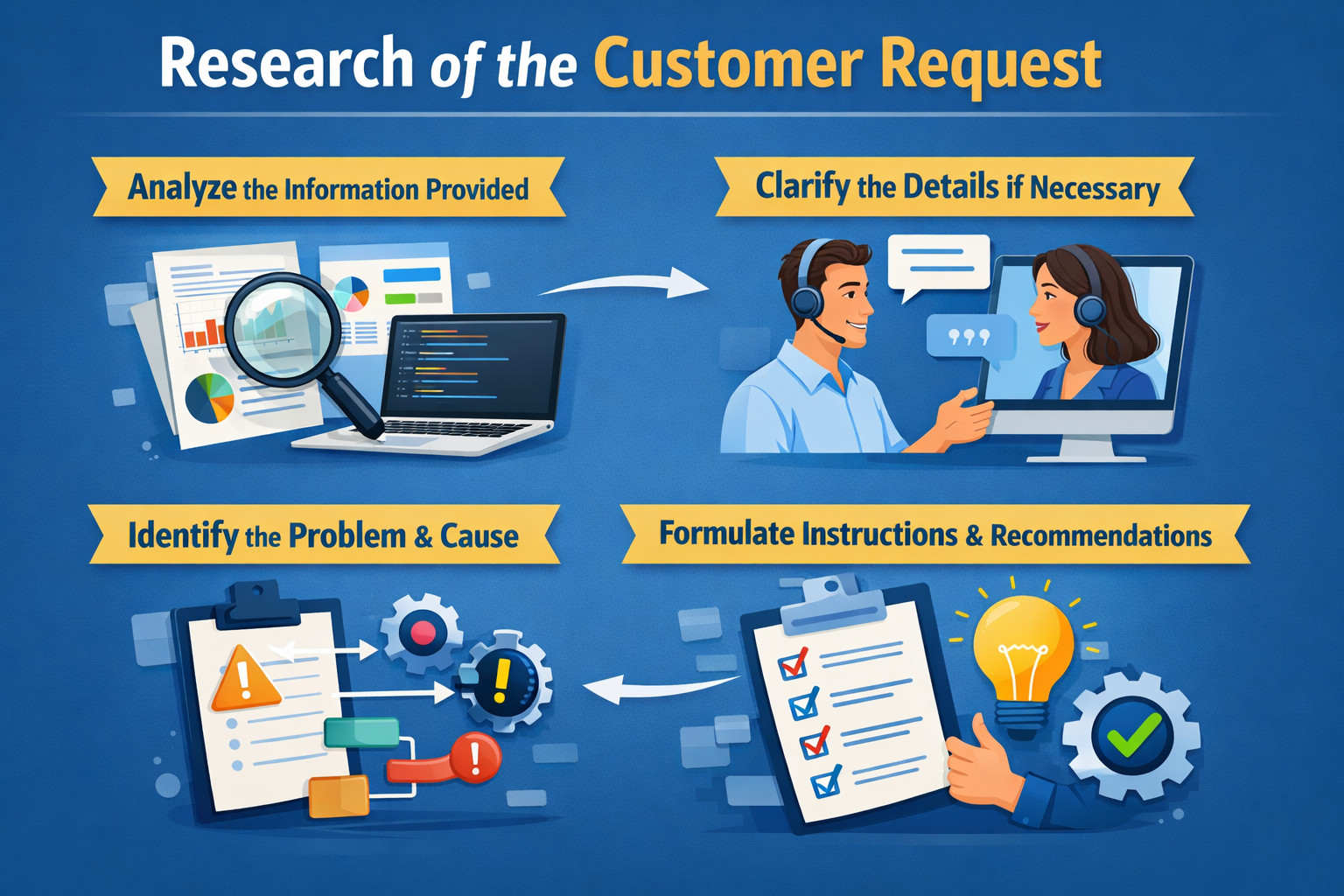
Step by step, we break down the request: what happened, under what conditions, and why the system behaved in this way. Often, the cause becomes clear when you delve deeper into the problem. Therefore, it is important to look at the situation more broadly, rather than looking for a quick answer. Most of the working day, from about 11 a.m. to 5 p.m., is taken up by this process.
Sometimes the line between a support analyst and a business analyst almost disappears. To really help, you need to understand not only the system interface, but also the business logic and overall architecture of the solution.
We recommend to read Cybersecurity for Business: How Odoo Keeps Your Data Safe
Continuous Learning Is Part of the Job
No two days are the same at Odoo. Every case is unique. Today you're figuring out VAT settings, tomorrow you're optimizing warehouse accounting, and the day after tomorrow you're analyzing why the POS shift isn't closing.
That's why learning is a constant part of the job. To improve our knowledge, we spend a few hours in the evening learning about Odoo's functionality, “Oblik-ERP,” and optimizing our own processes. This adds drive and makes the day interesting. Constant challenges and development bring real satisfaction when you realize that you have just solved a problem that at first glance seemed impossible.
Find out more Odoo ERP Support Made Simple: Challenges and Solutions
Acting as the Bridge Between Customers and Product Teams
A support analyst is, in fact, the voice of the customer within the company. We are in constant contact with the Oblik-ERP product and development teams to ensure that issues and ideas do not get lost along the way.
If we see that a case requires code intervention, we do not simply “pass on” the task. Instead, we prepare a clear and detailed description of the problem for the developers. We also involve other teams to improve functionality in the future.
Our goal is to be a reliable bridge between the user and the technical team. Thanks to this, complex solutions quickly reach the developer and return to the customer in the form of an understandable and convenient tool.
Conclusion: the role of a support analyst
Being a support analyst at Odoo is about empathy, technical expertise, and constant progress. We take care of the customer's system so that they can focus on their business.
Our work gives us a sense of purpose: every solution we offer helps businesses operate more efficiently. There is constant development and the opportunity to influence the product, take care of the system, and improve the user experience. This is what makes every day at SelfERP interesting, inspiring, and worth living.

Let's automate your business right now!
Пишіть тут...