Most large companies use generative AI, but few achieve lasting business value. Standalone tools can draft content, summarize calls, or explain trends, yet they lack access to the company’s operational data and business rules.
ERP provides that missing context. It connects AI to transactions, workflows, permissions, and audit trails across finance, procurement, inventory, manufacturing, and sales.
This article examines where GenAI-enabled ERP creates measurable value and which conditions — data quality, governance, security, and human oversight — are required to scale it.
The GenAI market and enterprise adoption
Five conclusions, drawn from the most current, credible research available, frame where the market actually stands.
- AI adoption is widespread, but enterprise-wide value remains limited: 88% of organizations use AI in at least one business function, while nearly two-thirds have yet to scale it and only 39% report an enterprise-level EBIT impact, according to McKinsey’s The State of AI in 2025 global survey.
- Workflow redesign separates AI high performers from the rest: McKinsey found that the roughly 6% of organizations generating more than 5% of EBIT from AI are nearly three times more likely to have fundamentally redesigned workflows around the technology.
- AI deployment is becoming more affordable: corporate AI investment reached $252.3 billion in 2024, while inference costs for GPT-3.5-level performance fell roughly 280-fold over 18 months, according to Stanford HAI’s AI Index Report 2025. This decline makes it more practical to embed AI into high-volume ERP workflows.
- AI-driven productivity gains are measurable but uneven: PwC found that productivity growth in the industries most exposed to AI rose from 7% in 2018–2022 to 27% in 2018–2024. According to PwC’s 2025 Global AI Jobs Barometer, the gains are concentrated in sectors such as financial services and software rather than distributed evenly across all companies.
Taken together, these findings support a narrower, more defensible version of the popular claim that "AI is transforming business". It means adoption is real and accelerating, but value is conditional on data quality, workflow redesign, and governance — exactly the conditions ERP is built to provide when implemented well, and exactly what standalone AI tools lack on their own.
Find out more Data-Driven Enterprise Systems for Predictive Operations
Why ERP is becoming the operational brain of the business
Generative AI models are trained on public information and general patterns of language and reasoning. They do not know, by default, that a specific customer's payment terms are net-45, that a specific supplier missed its last three delivery windows, or that a specific project is 22% over budget. An AI model can produce a fluent, generic answer to "why did margin decline." Only a system with access to the company's actual sales orders, cost of goods sold, freight expenses, and pricing exceptions can produce an answer that is actually about the company.
ERP systems hold exactly this kind of information:
- structured transactional data,
- master data (customers, vendors, items, chart of accounts),
- years of historical context,
- defined workflows and approval chains,
- role-based permissions,
- business rules,
- audit trails required for compliance,
- integration with banks, tax authorities, and logistics providers.
This is the operational substrate a general-purpose AI model lacks and a business needs before it can trust an AI-generated answer enough to act on it.
This is also where the limits of the "operational brain" framing matter. ERP does not replace human judgment, and connecting AI to ERP data does not make outputs automatically correct — it makes them more relevant and traceable to a verifiable source, provided the underlying data, permissions, and business rules are sound. Gartner's own research on this point is a useful check on enthusiasm: it projects that fewer than 10% of organizations that implement agentic AI inside their ERP systems will realize significant measurable value by 2027 without first addressing strategy, governance, and data quality.
How GenAI and ERP work together
When connected to ERP data, generative AI can support employees across reporting, document processing, decision-making, and workflows. The most relevant applications fall into five categories.
- Natural-language access to enterprise data. Employees can ask questions about delayed orders, margin changes, supplier performance, working capital, or project overruns without building custom reports. Reliable answers still require current data, consistent metric definitions, and appropriate access permissions.
- Automated document and content processing. GenAI can extract invoice data, summarize contracts, identify unusual clauses, classify service requests, and prepare draft reports or communications. These are relatively mature, lower-risk use cases because employees usually review the output before it affects transactions or customers.
- Decision support. AI can analyze company data to explain demand changes, identify cost anomalies, highlight cash-flow exposure, prioritize procurement issues, and flag unusual transactions. Its value comes from interpreting actual ERP records rather than relying on general knowledge.
- Workflow assistance. GenAI can guide employees through approvals, recommend next steps, assemble supporting documents, escalate exceptions, summarize outstanding tasks, and coordinate handoffs between departments.
- AI agents. Agents can monitor events such as delayed shipments, credit-limit breaches, or stockout risks and recommend or execute narrowly defined actions. This remains the least mature category: Gartner expects more than 40% of agentic AI projects to be canceled by the end of 2027 because of cost, unclear value, or weak risk controls. Human approval remains essential for consequential financial and operational decisions.
Overall, the most mature applications support employees with analysis, drafting, and exception management. Greater autonomy requires stronger data quality, defined business rules, clear approval limits, and continuous human oversight.
We recommend to read Top Odoo Tools for Manufacturing
What business value can GenAI-enabled ERP create?
GenAI-enabled ERP can improve business performance through specific operational gains rather than broad, abstract transformation. Its value is most visible where employees spend significant time searching for information, processing documents, resolving exceptions, and coordinating across functions.
Key benefits include:
- Faster access to information. Employees can retrieve operational and financial insights without manually building reports or searching across multiple systems.
- Lower administrative workload. AI can automate document extraction, classification, summarization, and first-draft preparation.
- Shorter process cycles. The system can identify stuck approvals, missing documents, and unresolved tasks before they cause larger delays.
- Better exception management. Continuous analysis of ERP transactions helps teams focus on anomalies, risks, and cases requiring attention.
- More consistent decisions. Similar cases can be evaluated using the same business rules, thresholds, and data definitions.
- Improved cross-functional coordination. Teams can access the same underlying information through a shared interface, reducing repeated requests and manual handoffs.
- Faster reporting. GenAI can generate draft explanations and management commentary based on verified ERP data.
- Stronger knowledge retention. Business knowledge can be captured in documented processes and workflows instead of remaining dependent on individual employees.
- Better employee experience. Automating repetitive, low-judgment tasks allows employees to focus on analysis, problem-solving, and decision-making.
- Greater process visibility. Managers can review the status of orders, approvals, projects, and exceptions across departments in plain language.
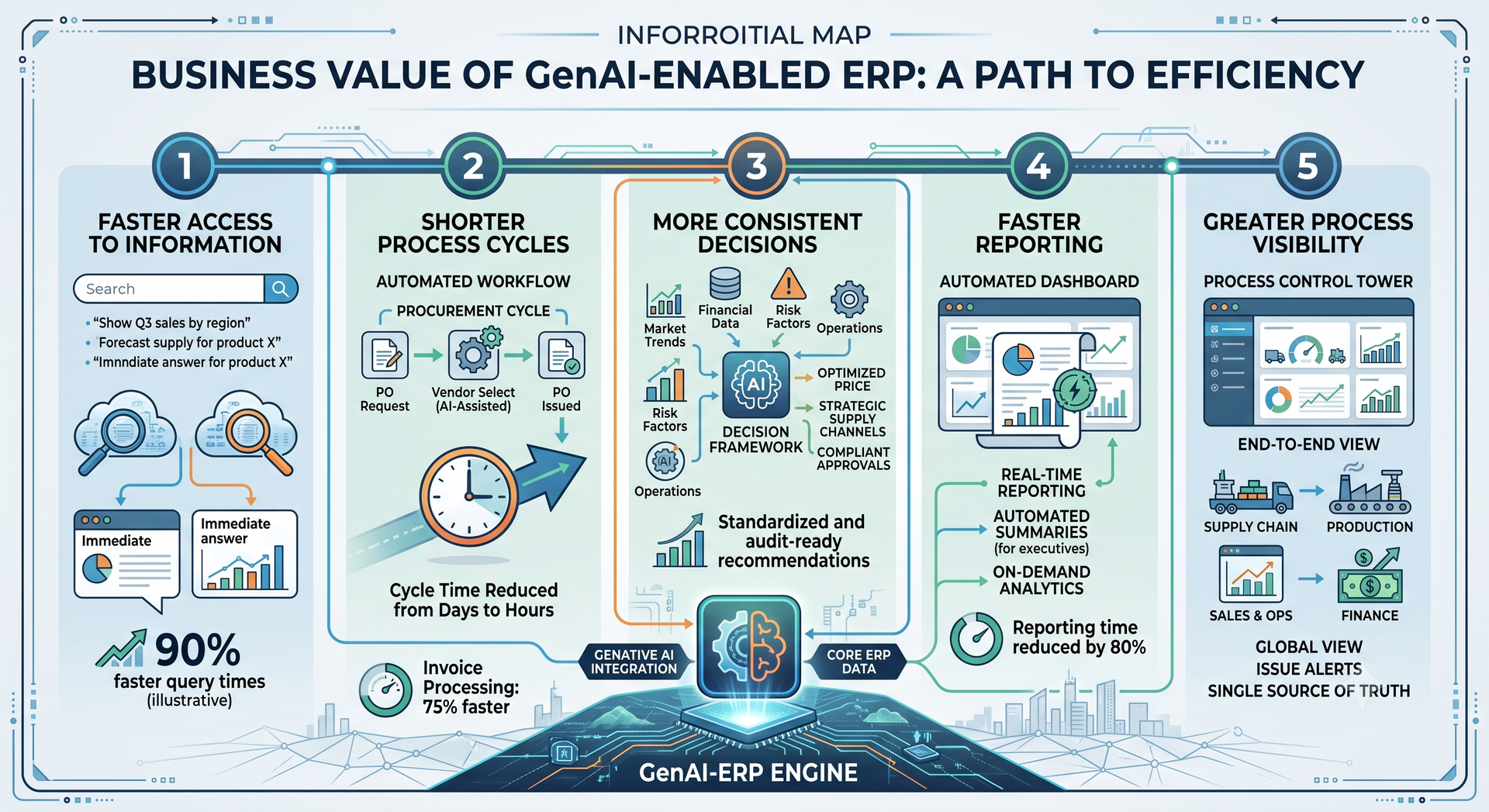
These benefits are achievable, but they are not automatic. The research cited earlier shows that measurable value depends on data quality, workflow integration, governance, and user adoption. Companies should therefore evaluate GenAI-enabled ERP through clear operational metrics, such as time saved, cycle-time reduction, error rates, processing costs, and financial impact.
The Most Common Mistakes That Prevent GenAI Projects From Scaling
GenAI projects often fail to scale because companies add an AI layer to an ERP environment that still has unresolved data, process, and governance issues.
The most common mistakes include:
- Fragmented data. Information spread across multiple ERP instances and disconnected systems gives AI only a partial view of the business.
- Poor master data quality. Duplicate customer records, inconsistent product codes, and outdated supplier terms lead to inaccurate outputs.
- Inconsistent metric definitions. Different interpretations of terms such as margin, active customer, or on-time delivery create conflicting answers.
- Undocumented processes. AI cannot reliably support workflows that depend on informal knowledge, emails, or individual judgment.
- Limited system integration. Missing connections with CRM, warehouse management, banking, and other platforms leave critical data gaps.
- Unclear ownership. Without a responsible business owner, no one is accountable for data quality, output review, or process improvement.
- Low user trust and adoption. Employees avoid tools that produce unsupported answers or provide no way to verify the result.
- Weak governance. Deloitte found that regulation and risk remain major barriers to adoption, while only a minority of companies have mature governance for autonomous AI agents.
- Insufficient security controls. Broad permissions, limited auditability, and unclear data-handling rules increase operational and compliance exposure.
- Excessive customization. Complex custom solutions become expensive to maintain and may break during ERP or model upgrades.
- Weak change management. Users may not understand how the system works, when to trust it, or how to escalate an incorrect output.
- Unclear success criteria. Projects are difficult to scale when companies cannot define which metric, cost, or process outcome should improve.
GenAI does not resolve weaknesses in the ERP environment. It inherits them. Poor data and unclear processes produce unreliable outputs faster and with greater apparent confidence.
You also may like the article What is a CRM system and how does it affect your business sales?
How to choose the first use case
Start with a frequent, clearly defined problem that has a measurable outcome, reliable ERP data, limited risk, and a human reviewer already involved in the workflow. The use case should also require minimal integration with systems outside the ERP.
A strong example is generating draft variance commentary for the monthly close, with an analyst reviewing the result. A poor starting point is an autonomous procurement agent placing orders without approval, especially when supplier data is incomplete or inconsistent.
Conclusion
Generative AI creates the most business value when it operates on trusted ERP data, inside defined workflows, with clear permissions, documented business rules, and a human positioned to review consequential decisions.
The practical takeaway for a management team is to start with a specific, measurable operational problem — a slow close process, a recurring supplier delay, a high-volume document task — and work backward to the right AI capability, rather than adopting generative AI first and searching for a use case afterward.
